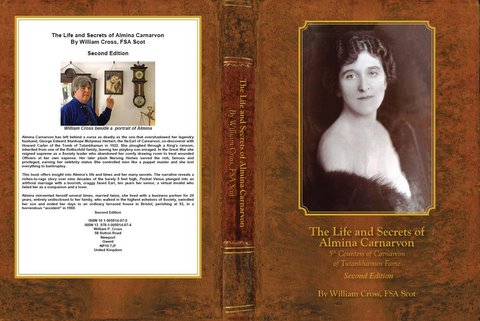
Extract From The Life and Secrets of Almina Carnarvon
Second Edition : To Be Published on 15 September 2011
A trailer for the book can be found on You Tube - Click Below
http://www.youtube.com/watch?v=SjrtJkiLxvQ
BOOK CHAPTER EXTRACT
Chapter 1
1876 to 1893
Daughter Almina
A mysterious beginning
The year 1876 is notable for many things. Queen Victoria was crowned Empress of India by her Prime Minister, Benjamin Disraeli. Alexander Graham Bell was granted a patent for an invention he called the telephone. Melvil Dewey invented his classification system. The United States celebrated its centenary. And Almina Victoria Marie Alexandra Wombwell, destined to be the 5th Countess of Carnarvon, was born.
In the late spring of that year, a heavily pregnant, well-to-do Frenchwoman stepped out of number 20, Bruton Street, London and made herself comfortable in a hansom cab bound for Victoria railway station. Marie Wombwell, aged 30, was leaving behind her Mayfair abode – on a street which great statesmen had called home and which would one day become H.M.Queen Elizabeth II’ s birthplace – to return to her native Paris, where she would welcome her second child into the world.
But Marie never made it to the London to Dover train or the subsequent crossing to Calais; indeed she didn’t even make it to Victoria. Gripped by early labour in the back of the lowly hansom cab, she was diverted to an address in Bayswater where, on 14 April, she gave birth to a daughter: Almina. Almina’s birthplace, at first glance, appears an obscure location to deliver a baby. Number 18, Bayswater Terrace, Bayswater was a hotel, described as “an establishment for families and gentlemen” – certainly a less fashionable address than Mayfair or Paris. Yet this place was an ideal retreat: a sanctuary that offered protection for all the parties concerned from the watchful eyes and chattering tongues of London society commentators. For Marie was estranged from her husband of eight years, Frederick Charles Wombwell, and it wasn’t quite clear who exactly had fathered her daughter...
Marie Wombwell née Boyer Almina’s mother, Marie Felicie Boyer (c.1846–1913) came from continental stock which straddled French and quasi-Spanish heritage. She was the daughter of Alexandre Boyer, a financier, and Victoria de los Dolores de Gogorza, of Paris.
The Boyers were old French aristocrats. Indeed, through their association Almina would grow up to speak fluent French with no hint of an accent, using the pre-guillotine pronunciation. Marie’s father, Alexandre Boyer, was an astute Parisian businessman involved in banking and property letting, but he also merits being counted as an inspired French-South-American colonist. Marie’s mother, Victoria de los Dolores de Gogorza, provided an infusion of respectable Spanish blood.
Marie was best known as being a Frenchwoman, but she once claimed that her birthplace was Venezuela, in South America. The likelihood is that she was born in France. Nonetheless, there is evidence of settlement by the Boyers in Maracaibo, the second City of Venezuela, from the 1840s. Records of the Boyer family’s financial wheeling and dealing exist here until at least the end of the 19th century.
Fred Wombwell
The man named as Almina’s father, Frederick (Fred Charles Wombwell (1845–1889), came from a strong lineage. He was a descendant of Robert de Wombwell who lived at the time of King Stephen. He was the youngest of the four sons of Sir George Wombwell, the 3rd Baronet of Wombwell (1792–1855). Fred’s mother Georgina (née Hunter; 1807–1875) was the daughter of Thomas Orby Hunter MP of Crowland Abbey, Lincolnshire.
For Fred, Newburgh Priory in North Yorkshire was home. To this day the Wombwells have their family seat there, at Easingwold near Coxwold. The site was once an Augustinian priory, granted by King Henry VIII to Antony Belasyse, from whom the Wombwells descended – indeed, one of Fred’s kin was the daughter and heiress of the last Lord Fauconberg. The priory is famed for its collection of Cromwellian relics; Mary Cromwell (a daughter of Oliver, the great Protector) was the wife of the second Lord Fauconberg.
After a public school education, Fred lived off allowances from family trust funds. This brought him a handsome income of 500 pounds a year. In his early twenties he featured regularly in the Sporting Intelligence section of newspapers, but from 1863 – and after coming of age at 21 – his press coverage reveals a weaker, flawed character. He divided his time between the racing circuit (he owned several horses) and engaging in a lavish social life. Thus, whilst the Carnarvon guidebooks mistakenly refer to Fred as a “Captain”, Almina’s birth certificate is closer to the mark when it describes Fred’s occupation as a “Gentleman.”
red was often in the company of his older brother Captain Henry (Harry) Herbert Wombwell (1840–1926), and the two enjoyed a reputation as promising gentleman-riders of the English county and French turf during the 1860s and 1870s. The brothers were great friends of the hapless Henry Rawdon-Hastings, 4th Marquis of Hastings (1842–1868), and they rode the Hastings’ horses and socialised extensively with the Marquis – travelling often to Scotland (to the Marquis’ seat at Loudon Castle, Ayrshire) and cruising across Europe’s waterways aboard the Hastings’ fine yachts.
In London Fred kept rooms at Limmer’s Hotel, Bond Street, a rough establishment frequented by the dregs of the sporting world. Fred’s brothers Harry and Ulick (1834–1886; another soldier, with the rank of Colonel) were like-minded frequenters of Limmer’s. But the youngest Wombwell brother Fred. was also forced, at times, to live with his widowed mother, Lady Georgina, at John Street, Berkeley Square, London, for too often Fred’s frivolous nature with money left him stoney-broke.
The youngest Wombwell brother should have been comfortable: at the age of 21 he had inherited the sum of 20,000 pounds. But in the year that followed he had run up large debts and made promissory notes against his inheritance. Debt stalked him at every turn, and he acquired a reputation as a rakish young man who did not pay his way, provoking creditors’ wrath.
Comments/ Questions Welcome
e-mail Author William Cross, FSA Scot